 MorphoDepot
MorphoDepot
MorphoDepot
MorphoDepot brings the fork-and-contribute workflow of open-source software to the segmentation of 3D specimen scans — so labs and contributors can build, review, and version anatomical datasets together.
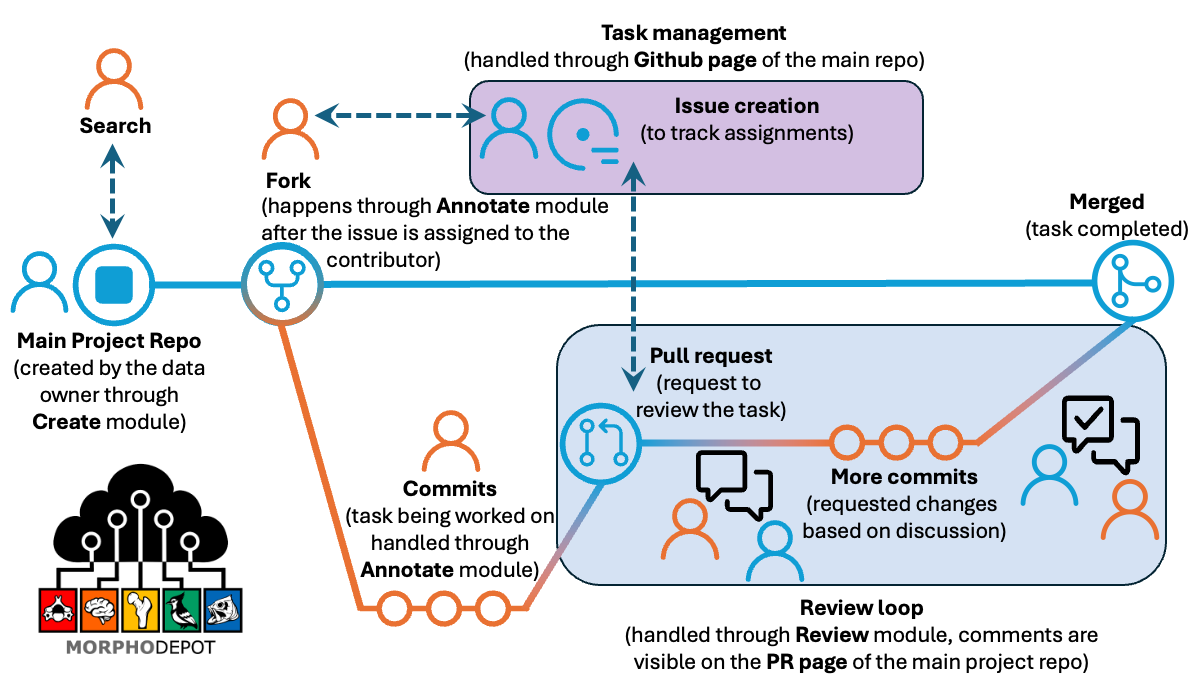
MorphoDepot is an open platform for the collaborative segmentation of 3D specimen data (CT, microCT, and other volumetric scans). It pairs a 3D Slicer extension with a GitHub organization, so each dataset lives in its own repository: the source volume is stored as a release asset, and every segmentation is a versioned file contributed, reviewed, and released through ordinary GitHub branches and pull requests.
The result is a transparent, attributable, and reproducible record of who segmented what — the same collaboration model that powers open-source software, applied to anatomy.
Read the full tutorial Step-by-step, with screenshots.
You choose a dataset's type when you create it, and the choice is permanent.
| Short-term | Archival | |
|---|---|---|
| Who can create | anyone | organization members only |
| Where it lives | your personal GitHub account | the MorphoDepot organization |
| Storage for the scan | GitHub attachment, up to 2 GB | Jetstream2 cloud storage, 10 GB by default |
| Citable (DOI) | no | yes |
| Governance | yours alone, delete anytime | community-governed |
| Best for | teaching, drafts, experiments | lasting, citable datasets |
Enrollment is open — sign in with your ORCID iD to set up your lab team.
A two-day workshop: Day 1 covers MorphoCloud operations and setup customization; Day 2 covers using MorphoDepot to assign and monitor 3D segmentation tasks. Register for either day — Day 1 is a prerequisite for Day 2.
RegisterMorphoDepot is supported by funding from the National Science Foundation (DBI/2301405). It runs on cyberinfrastructure that is made available by current and previous funding from the National Science Foundation (JetStream2: OAC/2005506), which provides the storage backend for archival datasets. Initial development of SlicerMorph was previously supported by the National Science Foundation (DBI/1759883).
If you use MorphoDepot in your research, please cite our paper:
Maga, A. M., Pieper, S., Donatelli, C., Gignac, P. M., Kolmann, M., Noto, C., Summers, A., & Taft, N. (2026). Forking anatomy: How MorphoDepot applies the open-source development model to 3D digital morphology. Methods in Ecology and Evolution.
doi.org/10.1111/2041-210x.70342
Please also acknowledge our funders with this statement:
This study relied on cyberinfrastructure supported by grants from the National Science Foundation (DBI/2301405; JetStream2: OAC/2005506).